

The Future of Legal Billing: 2025 and Beyond
Introduction: Why Legal Billing Is at a Crossroads
Legal billing is undergoing a profound transformation. As law firms and corporate legal departments face increasing demands for efficiency, accuracy, and compliance, the traditional methods of managing billing are rapidly becoming obsolete. The convergence of advanced technology, specialized expertise, and evolving client expectations is redefining what it means to manage legal billing in 2025 and beyond.
1. The Evolution of Legal Billing: From Manual Processes to Intelligent Automation
For decades, legal billing was synonymous with manual entry, paper invoices, and a constant risk of error and delay. Today, leading firms are embracing automation, artificial intelligence, and integrated cloud solutions to streamline the entire billing lifecycle. These advances are not just about speed—they deliver real-time insights, improved accuracy, and a measurable reduction in costly mistakes.
Key Developments Driving Change:
AI-Powered Automation: Modern eBilling platforms now handle everything from LEDES formatting to compliance checks, dramatically reducing manual workloads.
Cloud-Based Collaboration: Secure, remote-enabled systems enable seamless invoice review, submission, and appeals—critical for distributed teams.
Data-Driven Decision Making: Advanced analytics help firms identify bottlenecks, recover rejected invoices, and continuously refine billing strategies.
2. Compliance, Security, and the New Complexity of Client Demands
Fortune 500 clients and global organizations are enforcing increasingly stringent billing guidelines. The stakes are high: non-compliance leads to rejected invoices, delayed payments, and reputational risk. Staying ahead requires a proactive approach.
How High-Performing Firms Respond:
Automated Compliance Monitoring: Every invoice is rigorously checked against outside counsel guidelines before submission.
Enterprise-Grade Security: Industry leaders pursue SOC2 certification and deploy tools like VPNs and multi-factor authentication to safeguard sensitive billing data.
Continuous Training: Billing teams are regularly upskilled to keep pace with evolving standards and system requirements.
3. Outsourcing as a Strategic Advantage
Outsourcing legal billing is no longer just a cost-saving measure. It’s a strategic decision that unlocks new value and resilience for firms of every size.
Why Specialized Providers Make a Difference:
Deep Expertise: Teams with direct law firm experience and proficiency across all major eBilling systems.
Scalable Support: Resources can be quickly scaled to manage volume surges or system transitions.
Focus on Core Legal Work: Attorneys and staff are free to concentrate on client matters, not administrative burdens.
Smart eBill Team in Action:
Our team has helped clients eliminate multi-million-dollar invoice backlogs and built in-house capabilities that endure long after our engagement ends.
4. The Next Frontier: AI, Integration, and the Client Experience
Looking ahead, several trends are set to define the future of legal billing:
System Integration: eBilling platforms will connect seamlessly with practice management, expense, and reporting tools for a unified workflow.
Predictive Analytics: AI will forecast cash flow, flag compliance risks, and suggest process improvements before problems arise.
Client-Centric Solutions: Subscription models and transparent reporting will foster stronger, longer-term client relationships.
5. Preparing for What’s Next: Action Steps for Legal Leaders
To maintain a competitive edge, legal organizations should:
Review Current Billing Operations: Identify weaknesses in technology, expertise, or compliance.
Invest in Training and Change Management: Ensure teams can adapt to new systems and standards.
Partner with Proven Experts: Engage with specialists like Smart eBill Team to future-proof your billing operations.
Conclusion: Setting the Standard for Legal eBilling Excellence
Legal billing is no longer just a back-office function—it’s a strategic lever for law firm growth and client satisfaction. As the industry evolves, Smart eBill Team is committed to guiding organizations through every challenge and opportunity, delivering the expertise, technology, and support necessary to thrive in 2025 and beyond.
Ready to Transform Your Legal Billing?
Contact Smart eBill Team for a personalized consultation, or visit www.smartebillteam.com to learn more about our comprehensive eBilling solutions.

The ROI of Outsourcing Legal Billing: How Human Expertise and AI Efficiency Drive Law Firm Success
Legal billing is often cited as one of the most challenging aspects of law firm management. Between complex client guidelines, evolving compliance demands, and the sheer volume of invoices, even the most organized firms can find themselves overwhelmed. For law firms looking to improve cash flow, reduce errors, and free up valuable resources, outsourcing legal billing is emerging as a smart, strategic solution.
Why Law Firms Are Rethinking Legal Billing
Many law firms—large and small—are discovering that traditional, in-house billing processes can be a costly bottleneck. Disorganized billing departments, frequent invoice rejections, and a lack of eBilling expertise can lead to significant revenue delays and frustrated teams. In today’s competitive legal landscape, efficiency isn’t just a nice-to-have; it’s essential.
That’s where outsourcing legal billing comes in. By partnering with a team that specializes in legal billing, law firms can streamline their operations, improve accuracy, and focus their internal resources on what matters most: practicing law and serving clients.
The Power of Human Expertise + AI Efficiency
At Smart eBill Team, we combine the best of both worlds: seasoned legal billing professionals and advanced AI-driven processes. Our team members have extensive law firm backgrounds and understand the nuances of legal eBilling, compliance, and client expectations. We pair this expertise with technology that automates repetitive tasks, flags potential errors, and accelerates invoice turnaround—without requiring you to invest in new software.
Key benefits of our approach include:
Faster invoice processing: Our average turnaround is just a few hours, helping law firms get paid sooner.
Reduced errors and rejections: Expert review combined with AI-powered checks means more invoices accepted on the first submission.
Scalable support: Whether you’re a boutique firm or a global powerhouse, our team adapts to your needs—no hiring headaches or training delays.
Resource optimization: Free your attorneys and staff from billing admin so they can focus on client work and business development.
Real Results: The ROI of Outsourcing Legal Billing
Our clients consistently report measurable improvements after outsourcing their legal billing. Faster payments, fewer rejected invoices, and more time for client service are just the beginning. For example, one firm we worked with reduced a $10M invoice backlog and saw a dramatic increase in billing team productivity after engaging our services.
What does this mean for your firm?
Improved cash flow and financial predictability
Enhanced compliance with client billing guidelines
Greater peace of mind, knowing experts are handling your billing
No New Software Required
A common misconception is that outsourcing legal billing means adopting a new software platform. Not with Smart eBill Team. We work seamlessly within your existing eBilling systems—Tymetrix 360, Collaborati, Brightflag, Legal X, and many more. Our consultants are fluent in all major platforms and can even provide training to help your team maximize your current tools.
Complete Transparency and Control
Outsourcing doesn’t mean losing control. With Smart eBill Team, you gain a true partner who values transparency, clear communication, and accountability. You’ll receive regular reports, have a dedicated point of contact, and always know the status of your invoices.
Ready to Transform Your Firm’s Billing?
Legal billing isn’t getting any simpler. The firms that thrive will be those who embrace smarter, more agile solutions. By outsourcing your legal billing to a team that blends human expertise with AI efficiency, you can unlock real ROI—without the learning curve of new technology.
Interested in learning more?
Contact Smart eBill Team at info@smartebillteam.com or call (202) 349-3964. Let’s discuss how we can help your law firm streamline billing, reduce costs, and set a new standard for efficiency.
Smart eBill Team LLC
Your partner in legal billing excellence—driven by people, powered by technology.
SEO Keywords integrated:
Outsourcing legal billing
Legal billing efficiency
Law firm billing solutions
Legal eBilling services
AI in legal billing
Legal billing compliance
Invoice processing for law firms

How to Choose the Right eBilling Vendor: What to Look for in AI Capabilities
Published July 21, 2025
Why Your Next eBilling Vendor Should Be Judged by Their AI
Let’s be honest: Legal billing isn’t getting any easier. Clients are more demanding, compliance rules are tighter, and the volume of invoices keeps climbing. The days of “good enough” billing teams are over. If you’re shopping for an eBilling partner, you need one who brings more than just bodies and basic software to the table. The real game-changer? Smart, practical AI that actually solves the headaches you deal with every week.
But how do you cut through the marketing noise and pick a vendor whose “AI” is more than a buzzword?
1. Start With Your Real-World Pain Points
Forget the sales demos for a second. What’s actually slowing your team down? Is it the endless back-and-forth over rejected invoices? Are your lawyers frustrated by compliance reviews that take forever? Or maybe you’re tired of chasing down old accounts receivable. The best vendors will start the conversation by asking about your workflow—not just showing off their dashboard.
2. Don’t Settle for “AI” in Name Only
Here’s the truth: Most vendors will claim to have AI, but many are just running simple automations behind the scenes. Push for specifics:
Automated Compliance Reviews: Can their system flag guideline violations before you submit, or does it only catch mistakes after the fact?
Intelligent Error Detection: Does their platform actually learn from your billing patterns to spot duplicates and unusual entries, or is it just running basic checks?
Predictive Analytics: Will it help you anticipate bottlenecks and prioritize backlogged invoices, or are you still relying on spreadsheets?
Integration with Your Systems: Can their AI work with the platforms you already use—like Legal Tracker, Tymetrix 360, Collaborati, Brightflag, and others? Or will you be forced into a messy migration?
3. Transparency Matters—Don’t Accept a Black Box
AI should make your life easier, not more mysterious. Look for vendors who offer:
Customizable Rules: You should be able to tweak compliance settings to fit your client’s unique guidelines.
Audit Trails: Every AI-driven suggestion or correction should be documented, so you know exactly why an invoice was flagged or changed.
4. People Still Matter—AI Isn’t a Substitute for Expertise
No matter how sharp the platform, you need a team that understands the realities of legal billing. Ask about their consultants’ backgrounds. Do they have real law firm experience, or are they just techies? Find out how they handle onboarding, training, and support when things get complicated.
5. Ask for Results, Not Promises
The best vendors will show you hard numbers: reduced rejection rates, faster payment cycles, and time saved for your staff. Ask for case studies or sample reports. Don’t accept vague claims—demand proof.
6. Choose a Partner Who’s Focused on the Future
AI in legal billing is changing fast. You want a vendor who’s committed to continuous improvement—staying on top of compliance trends, security standards, and new integrations. Ask how often they update their platform and how they incorporate client feedback.
The Bottom Line
Choosing an eBilling vendor isn’t just about ticking boxes. You need a partner who understands your world, brings real AI to the table, and backs it up with legal billing expertise. When you find that, you’ll spend less time firefighting and more time focused on your clients.
If you’re ready to see what smart, transparent, and truly effective eBilling looks like, let’s connect. We’ve been in your shoes—and we know what works.
Want more practical tips on legal billing and technology? Subscribe to our newsletter.
Ready to talk specifics? Reach out—we’re always happy to share what we’ve learned.

Understanding Outside Counsel Guidelines (OCGs): Essential Insights for Law Firms
Outside Counsel Guidelines (OCGs) are now an integral part of the legal services landscape, especially for law firms serving corporate clients. For many firms, the difference between a seamless client relationship and repeated invoice rejections often comes down to how well OCGs are understood and implemented. Below, we break down what OCGs are, why they matter, and how your firm can stay ahead of compliance challenges.

What Are Outside Counsel Guidelines?
OCGs are client-issued documents that set forth the requirements, standards, and expectations for outside legal service providers. These guidelines go well beyond basic billing instructions—they define how legal work should be staffed, managed, and reported, and they specify how and when invoices must be submitted.
Why are they critical?
Failure to comply with OCGs is one of the most common reasons for delayed or rejected invoices, leading to unnecessary administrative work, slower payments, and sometimes even jeopardized client relationships.
Key Elements of OCGs Your Firm Must Master
1. Preapproved Activities and Activities Requiring Preapproval
Clients often distinguish between “preapproved” activities (those you can bill for without additional permissions) and those that require explicit preapproval.
Examples of preapproval requirements: Engaging expert witnesses, conducting extensive legal research, or incurring significant travel expenses.
Action: Always verify which activities require preapproval before commencing work to avoid non-billable hours.
2. Billing Deadlines
Most OCGs specify strict billing timelines—sometimes as short as 30 or even 15 days from the date of service.
Consequence: Missing these deadlines can result in automatic rejection of invoices, impacting your cash flow and client satisfaction.
Best practice: Implement internal reminders and workflows to ensure all timekeepers and billing staff are aligned with client deadlines.
3. Requests for Specific Information
Many clients require law firms to provide additional documentation alongside invoices, such as:
Budgets and accruals
Staffing plans
Detailed matter updates or periodic reports
Failure to provide this information as requested can lead to invoice delays or rejections.
4. eBilling System Requirements
Increasingly, clients require law firms to submit invoices via specific eBilling platforms (such as Tymetrix 360, Collaborati, or Legal X).
Compliance tip: Confirm the required platform for each client, ensure your team is trained, and test your invoice file formats before first submission.
5. Legal Department Contact Information
OCGs may specify exactly where and to whom invoices or communications should be sent.
Risk: Sending invoices to the wrong contact or department can result in lost or delayed payments.
Solution: Maintain an up-to-date directory of client contacts and confirm these details during onboarding and whenever guidelines are updated.
6. Supporting Documentation
Some guidelines require additional documentation, such as:
Receipts for expenses
Detailed time entries
Compliance certifications
Having standardized templates and checklists can streamline this process and reduce errors.
The Cost of Non-Compliance
Non-compliance with OCGs can lead to:
Invoice rejections and payment delays
Reduced client trust
Increased administrative burden
Potential loss of business
Given that many law firms operate on thin margins and tight timelines, these risks are significant.
How Smart eBill Team Supports OCG Compliance
At Smart eBill Team, we understand the complexity and importance of OCG compliance. Our specialized services help law firms:
Analyze and summarize OCGs for actionable insights
Configure and test eBilling systems for compliance
Support invoice submission, appeals, and troubleshooting
Deliver tailored training to keep your team current on evolving client requirements
Our consultants—all with in-house law firm experience—focus exclusively on eBilling, ensuring that your firm’s billing practices are both compliant and efficient.
Final Thoughts
Outside Counsel Guidelines are not just a formality—they are a fundamental part of the modern client relationship. By proactively managing OCG compliance, your firm can reduce billing friction, accelerate payments, and enhance client satisfaction.
If your firm needs expert guidance or hands-on support with OCG compliance and eBilling, contact Smart eBill Team today.
About Smart eBill Team
Smart eBill Team is a US-based provider specializing in outsourced legal eBilling and billing technology solutions and training. We help law firms and legal departments optimize billing processes, improve compliance, and focus on what matters most—delivering exceptional legal services. Contact us for more information today info@smartebillteam.com.

AI in Legal Billing: What’s Hype, What’s Real?
Artificial intelligence has become the legal industry’s favorite buzzword, promising to transform everything from contract review to client communications. Nowhere is this promise more hotly debated than in the world of legal billing. As professionals who live and breathe legal billing every day, we at Smart eBill Team have seen firsthand where AI is genuinely changing the game—and where the reality doesn’t quite match the headlines.
The Hype: Separating Fact from Fiction
Let’s start by addressing a few of the biggest misconceptions:
“AI will replace billing specialists.”
This idea gets a lot of airtime, but it’s far from the truth. While AI can handle repetitive tasks—like pulling data from timekeeping systems or flagging obvious errors—legal billing is rarely that simple. Interpreting outside counsel guidelines, resolving nuanced disputes, and communicating with clients all require experience, judgment, and a deep understanding of the legal landscape. Technology is a tool, not a substitute for expertise.
“AI can eliminate all billing errors.”
Automated checks and validations can certainly reduce mistakes, but billing errors aren’t always black and white. Many stem from complex client requirements or ambiguous entries that require a human touch. No software, no matter how advanced, can fully replace the value of a skilled billing professional reviewing an invoice before it goes out the door.
“AI is a plug-and-play solution for every firm.”
The legal industry is anything but uniform. Firms use a wide variety of billing systems and formats, and each client has their own rules and preferences. Off-the-shelf AI solutions rarely fit perfectly out of the box. Real success comes from tailoring technology to each firm’s needs and integrating it thoughtfully into established workflows.
The Reality: Where AI Delivers
Despite the hype, there’s no denying that AI is already making a meaningful impact on legal billing—when used wisely.
Automating Routine Workflows
AI excels at streamlining the work that slows teams down: extracting data, formatting invoices, flagging compliance issues, and tracking invoice status. By automating these steps, billing professionals are freed up to focus on more strategic, value-added tasks.
Enhancing Compliance and Accuracy
With the right setup, AI can help firms stay on top of ever-changing billing guidelines, spot recurring issues, and suggest fixes before invoices are even submitted. The result? Fewer rejections, faster payments, and happier clients.
Turning Data into Insights
One of AI’s greatest strengths is making sense of large volumes of billing data. Firms can now track trends in rejection rates, appeal outcomes, and turnaround times, using these insights to refine their processes and deliver better results.
Supporting Growth and Scalability
As firms expand, so does the complexity of their billing. AI helps maintain consistency and quality across teams, regardless of size or geography, making it easier to scale without sacrificing accuracy.
The Smart eBill Team Approach
At Smart eBill Team, we see AI as an extension of our expertise—not a replacement for it. Our consultants bring years of in-house law firm experience to the table, and we use AI to enhance, not overshadow, that knowledge. Every solution we implement is tailored to our clients’ real-world needs, ensuring that technology works for them—not the other way around.
Looking Ahead: The Next Chapter for AI in Legal Billing
The next wave of innovation will be about deeper, smarter integration. We’re already seeing AI tools built directly into major eBilling platforms and new capabilities like automated appeals, predictive analytics, and self-service options for clients and attorneys. At Smart eBill Team, we’re at the forefront of these developments, ensuring our clients are always a step ahead.
Final Thoughts
There’s no question that AI is reshaping legal billing, but the story is more complex—and more exciting—than the hype suggests. The best results come from combining smart technology with real-world experience, judgment, and client focus. That’s our commitment at Smart eBill Team: delivering real value, not just buzzwords.
If you’re ready to see what a thoughtful, expert-driven approach to AI in legal billing can do for your firm, we’d love to talk! Contact us at info@smartebillteam.com.

Top 5 eBilling Mistakes Law Firms Make (and How to Avoid Them)
In today’s legal landscape, efficient and compliant eBilling is not just a back-office function—it’s a strategic driver of profitability and client satisfaction. Yet, even the most sophisticated law firms encounter recurring pitfalls that can result in delayed payments, write-downs, and strained client relationships. Drawing on Smart eBill Team’s extensive experience supporting law firms and legal departments worldwide, we’ve identified the five most common eBilling mistakes—and actionable strategies to avoid them.
1. Inconsistent Compliance with Outside Counsel Guidelines
The Mistake:
Many firms overlook the nuances in client-specific billing guidelines, resulting in non-compliant invoices, frequent rejections, and ultimately, revenue leakage.
How to Avoid It:
Establish a centralized repository for client billing guidelines, accessible to all billing and timekeeping staff.
Implement regular training sessions and update workflows as guidelines evolve.
Leverage technology to automate compliance checks and flag discrepancies before submission.
2. Insufficient Training on eBilling Systems
The Mistake:
A lack of structured training leads to errors in invoice coding, submission processes, and appeals, particularly as firms adopt multiple eBilling platforms.
How to Avoid It:
Develop a comprehensive onboarding and ongoing training program covering all supported eBilling systems (e.g., Brightflag, Legal Tracker, BillBlast, Ebillinghub, Elite 3E, ProLaw, Chrome River).
Provide role-specific training for timekeepers, billing coordinators, and support staff.
Utilize educational tools and scenario-based learning to reinforce best practices.
3. Failure to Monitor and Resolve Rejections Promptly
The Mistake:
Unaddressed invoice rejections can cause significant cash flow delays and damage client trust.
How to Avoid It:
Assign dedicated personnel or outsource to eBilling specialists for real-time monitoring of invoice status across platforms.
Implement a standardized process for researching, resolving, and documenting rejections and appeals.
Use analytics to track rejection trends and address systemic issues at their source.
4. Neglecting to Update Matter and Client Setups
The Mistake:
Outdated matter data, incorrect client configurations, or missing tax information can trigger technical rejections and compliance failures.
How to Avoid It:
Schedule regular audits of client and matter setups within all eBilling systems.
Collaborate closely with IT and client contacts to ensure that all information is current and aligned with client requirements.
Automate data validation where possible to minimize manual errors.
5. Underestimating the Importance of Documentation and Reporting
The Mistake:
Inadequate documentation of billing activities and poor reporting hinder transparency and make it difficult to defend invoices during audits or appeals.
How to Avoid It:
Maintain detailed records of all billing transactions, guideline interpretations, and correspondence related to invoice disputes.
Invest in reporting tools that provide visibility into key metrics such as rejection rates, recovery times, and compliance performance.
Share regular reports with clients to demonstrate value and foster trust.
Elevate Your Firm’s eBilling Performance
Avoiding these common mistakes requires more than just technical know-how—it demands a culture of continuous improvement, robust training, and the right technology partners. At Smart eBill Team, we empower law firms to optimize their eBilling processes, reduce write-offs, and enhance client satisfaction through tailored training, system expertise, and proactive support.
Ready to transform your firm’s eBilling?
Visit smartebillteam.com or contact us for a personalized consultation.
About Smart eBill Team:
With over 500 years of combined legal billing experience and $65M+ in eBilled invoices, Smart eBill Team delivers comprehensive eBilling solutions for law firms and legal departments of all sizes. Our US-based consultants are experts in every major eBilling and timekeeping platform, committed to professionalism, innovation, and client success.

How We Cut Billing Time by At Least 40% for a National Law Firm
“Through targeted process optimization and advanced automation, Smart eBill Team reduced the billing cycle for a national law firm by 40%—a result that outpaces typical industry improvements. This acceleration not only improved cash flow but also reduced administrative burden and enhanced client satisfaction.”
Introduction
In the legal sector, time is not just money—it is the difference between growth and stagnation. Law firms that struggle with inefficient billing processes often face delayed payments, increased write-offs, and strained client relationships. At Smart eBill Team, we specialize in transforming these challenges into operational advantages. Here, we detail how our team reduced billing time by 40% for a prominent national law firm, delivering measurable impact and sustainable efficiencies.
The Challenge: Persistent Billing Inefficiencies
A national law firm engaged Smart eBill Team to address a recurring set of challenges:
Manual, labor-intensive billing processes that consumed excessive attorney and staff time.
Frequent invoice rejections due to non-compliance with client billing guidelines.
Backlogs of unprocessed invoices, leading to delayed revenue recognition and increased administrative burden.
Limited in-house eBilling expertise and insufficient internal resources to keep pace with growing client demands.
These issues were not unique to this firm; they are common pain points for many legal organizations navigating complex eBilling systems and evolving compliance requirements.
Our Approach: Tailored, Technology-Driven Transformation
Every engagement at Smart eBill Team begins with a rigorous assessment of the client’s unique needs, systems, and objectives. For this law firm, we deployed a multi-phase strategy:
1. Comprehensive Process Analysis
Workflow Mapping: We conducted a detailed mapping of the firm’s billing operations, identifying bottlenecks and points of manual intervention.
System Audit: Our consultants reviewed the firm’s eBilling platforms, integrations, and data flows to uncover inefficiencies.
2. Targeted Optimization and Automation
System Configuration: We reconfigured eBilling systems to automate repetitive tasks, improve data accuracy, and streamline submissions.
Automated Compliance Checks: Our team implemented automated rule checks to ensure every invoice met client-specific guidelines before submission, significantly reducing rejection rates.
3. Staff Training and Change Management
Customized Training: Attorneys, timekeepers, and billing staff received tailored training on best practices for time entry, narrative standards, and compliance documentation.
Ongoing Support: We established dedicated support channels and provided real-time troubleshooting to ensure smooth adoption of new processes.
4. Real-Time Reporting and Continuous Improvement
Performance Dashboards: We introduced real-time dashboards for tracking invoice status, rejection trends, and recovery rates.
Continuous Feedback: Ongoing collaboration with the client allowed for iterative process refinements and rapid response to emerging challenges.
Results: 40% Reduction in Billing Cycle Time
Within three months, the law firm realized tangible improvements:
Billing Time Reduced by 40%: The end-to-end billing cycle, from time entry to payment, was shortened from weeks to days.
Invoice Rejections Cut by 50%: Automated compliance and quality assurance drastically reduced the need for appeals and resubmissions.
Enhanced Productivity: Attorneys and staff redirected time previously spent on billing toward higher-value client work.
Stronger Client Relationships: Faster, more accurate billing improved client satisfaction and reinforced the firm’s reputation for reliability.
Why Smart eBill Team?
Our results are driven by three core strengths:
Deep Legal Industry Expertise: Every consultant brings in-house law firm experience and specialized knowledge of legal billing systems.
Client-Centric, Scalable Solutions: We tailor our services to each client’s unique requirements, ensuring solutions are practical and adaptable.
Commitment to Innovation: By leveraging the latest in automation and AI, we help firms stay ahead of industry trends and compliance demands.
Transform Your Firm’s Billing Operations
Smart eBill Team is dedicated to helping law firms unlock greater efficiency, accuracy, and client satisfaction through expert-led eBilling solutions. If your organization is seeking to reduce billing time, eliminate compliance headaches, or scale operations, we invite you to connect with us.
Contact us today to learn how Smart eBill Team can help your firm achieve similar results.
About Smart eBill Team
Smart eBill Team LLC is a US-based consulting firm specializing in legal billing and eBilling solutions for law firms and legal departments. Our team combines deep industry expertise with advanced technology to deliver measurable results for clients nationwide.
For more information, visit www.smartebillteam.com.

How We Reconcile, Map, and Ensure Compliance Across Complex Legal Billing Systems
In today’s legal landscape, managing multiple eBilling and Time & Billing platforms isn’t just a technical challenge—it’s a mission-critical responsibility. At Smart eBill Team, we recognize that every law firm and legal department operates within a unique ecosystem of systems, formats, and compliance requirements. Our commitment is to make these complexities invisible to our clients, delivering seamless, accurate, and compliant billing every time.
Our Approach: Mapping & Reconciling for Precision
System Mapping: We begin every engagement by meticulously mapping all relevant billing systems—whether it’s Tymetrix 360, Collaborati, Brightflag, SAP Ariba, or any of the 25+ platforms we support. This includes mapping LEDES file formats, user-defined fields, and client-specific billing codes to ensure data consistency and integrity across platforms.
Reconciliation: Our team performs end-to-end invoice reconciliation, ensuring that every submission aligns with client guidelines and internal accounting systems. This reduces errors, accelerates payment cycles, and provides a clear audit trail for every transaction.
Ongoing Compliance: We stay current with evolving billing guidelines and compliance standards, adapting our processes to each client’s requirements and industry expectations.
Real-World Story: Turning Complexity into Confidence
Recently, a global law firm approached us with a daunting challenge: they were managing billing across five disparate systems, each with its own compliance protocols and reporting requirements. Invoices were being rejected due to inconsistent data mapping and missed guideline nuances, resulting in delayed payments and client frustration.
Our team stepped in and:
Conducted a comprehensive audit of all eBilling touchpoints and mapped out every data field, rule, and exception.
Developed a centralized reconciliation protocol, ensuring that invoices were validated against both client and system requirements before submission.
Provided tailored training to the client’s billing staff, empowering them to identify and resolve compliance issues proactively.
The Result:
Within three months, the firm saw a 40% reduction in invoice rejections, a measurable improvement in cash flow, and—most importantly—renewed confidence in their billing operations.
Why It Matters
For law firms and legal departments, the cost of non-compliance is more than just financial—it’s reputational. At Smart eBill Team, we bring deep expertise, advanced technology, and a client-first mindset to every project, ensuring your billing is not only accurate but also fully compliant, no matter how complex your systems.
Ready to simplify your billing operations and ensure compliance at every step?
Let’s connect. Visit Smart eBill Team or reach out directly for a confidential consultation.

Why AI-Enabled Expertise Is the Future of Legal Billing
How Smart eBill Team Combines Human Experience with Intelligent Automation for Superior Results
Introduction
The legal sector is undergoing rapid transformation, with artificial intelligence (AI) reshaping how law firms and corporate legal departments manage billing. Yet, the most effective solutions don’t replace people—they empower them. At Smart eBill Team, we leverage AI-driven tools and decades of in-house expertise to deliver precise, efficient, and compliant legal billing services. Our model is clear: we are not a software company. Instead, we are a highly specialized team using advanced technology to help our clients thrive in a complex billing environment.
The Challenge: Traditional Billing Is Costly and Inefficient
Manual Burden: Legal billing remains one of the most labor-intensive processes in law firms, often leading to errors, write-downs, and delayed payments.
Compliance Complexity: Navigating outside counsel guidelines and multiple eBilling systems is a constant challenge, especially for firms with limited resources.
Resource Gaps: Many legal teams lack the bandwidth or expertise to keep up with high-volume, high-stakes billing demands.
The Smart eBill Team Solution: People + AI-Driven Processes
1. Human Expertise at the Core
Unmatched Experience: Our consultants bring over 500 years of combined legal billing experience, supporting prestigious law firms, Fortune 500 companies, and global organizations.
Comprehensive Service: We handle every aspect of eBilling—from invoice preparation and appeals to system configuration, training, and compliance reviews.
2. AI-Enhanced Workflows (But Never “Software Only”)
Process Automation: We utilize industry-leading AI tools to automate repetitive, error-prone tasks—such as invoice validation, compliance checks, and data reconciliation—while ensuring every action is overseen by a skilled professional.
Pattern Recognition: AI helps our team quickly identify trends in billing rejections, optimize appeals, and provide actionable insights for our clients.
Advanced Analytics: Through AI-enabled reporting, clients gain transparency into billing performance, bottlenecks, and recovery opportunities.
3. Personalized, Client-Centric Support
Tailored Onboarding: Every engagement is led by experienced eBillers who personally guide clients through onboarding, training, and ongoing support.
Continuous Improvement: AI helps us monitor outcomes and refine our processes, but it is our people who ensure every client’s needs are met with care and precision.
The Results: Efficiency, Accuracy, and Peace of Mind
$65 Million+ eBilled: We have successfully managed and submitted over $65 million in invoices, reducing backlogs and increasing revenue for our clients.
Write-Down Reduction: Our AI-empowered processes minimize costly errors and write-offs, directly improving profitability.
Risk-Free Trial: Clients can experience our service with a 60-day trial and no long-term commitment, ensuring confidence in our approach.
Why AI-Enabled Service—Not Just Software—Is the Future
Technology Alone Isn’t Enough: While AI is transforming legal billing, software without expert oversight can introduce new risks. Our model integrates AI with highly trained professionals, ensuring both accuracy and accountability.
Scalable, Flexible Solutions: Whether your firm has 40 or 4,000 attorneys, our team adapts to your needs, supported by intelligent automation that scales with your business.
Trusted by Leading Firms: Our people-powered, AI-enhanced approach has earned the trust of top law firms and corporate legal departments worldwide.
Conclusion
The future of legal billing lies in the synergy between human expertise and intelligent automation. Smart eBill Team is uniquely positioned to deliver on this promise—not as a software vendor, but as a trusted partner who brings together the best of technology and people. Let us handle your billing challenges so you can focus on what matters most: practicing law and serving your clients.
To learn how Smart eBill Team’s AI-enabled billing services can transform your firm, visit smartebillteam.com or contact us at (202) 349-3964 or info@smartebillteam.com.

Smart eBill Team: 100% Paperless and Proudly Supporting a Greener D.C. on World Environment Day
By Smart eBill Team | June 5, 2025
Setting the Sustainability Standard in Legal Billing
At Smart eBill Team, sustainability is not a trend—it’s a core value and a business imperative. On this World Environment Day, we are proud to showcase how our 100% paperless operations and community engagement initiatives are shaping a more responsible future for our industry and our city.
100% Paperless: Transforming Legal Billing for the Environment
The legal profession has historically been synonymous with paperwork—reams of printed invoices, compliance documents, and client files. We recognized early on that this legacy model was not only inefficient but also unsustainable for the planet. That’s why Smart eBill Team made a strategic commitment to go fully paperless across every facet of our business.
What Does 100% Paperless Mean for Our Clients and the Planet?
Zero Paper Waste: Every invoice, report, and client communication is managed digitally, eliminating the need for physical printing and storage.
Cloud-Based Efficiency: Our secure, cloud-driven systems enable real-time collaboration, instant invoice submission, and seamless approvals—no matter where our clients or consultants are located.
Enhanced Data Security: Digital workflows ensure encrypted storage, secure access, and robust audit trails, supporting compliance and client trust.
Environmental Leadership: By removing paper from our processes, we drastically reduce our carbon footprint and set a new benchmark for eco-conscious legal service providers.
Our paperless approach is not just about technology—it’s about accountability. Each year, we help our clients avoid the use of thousands of sheets of paper, reducing waste and supporting broader sustainability goals across the legal sector.
Beyond the Office: Our Commitment to Washington, D.C. Through Adopt-a-Block
Sustainability is more than a business practice; it’s a community responsibility. As a proud member of the Washington, D.C. business community, Smart eBill Team is an active participant in the city’s Adopt-a-Block program.
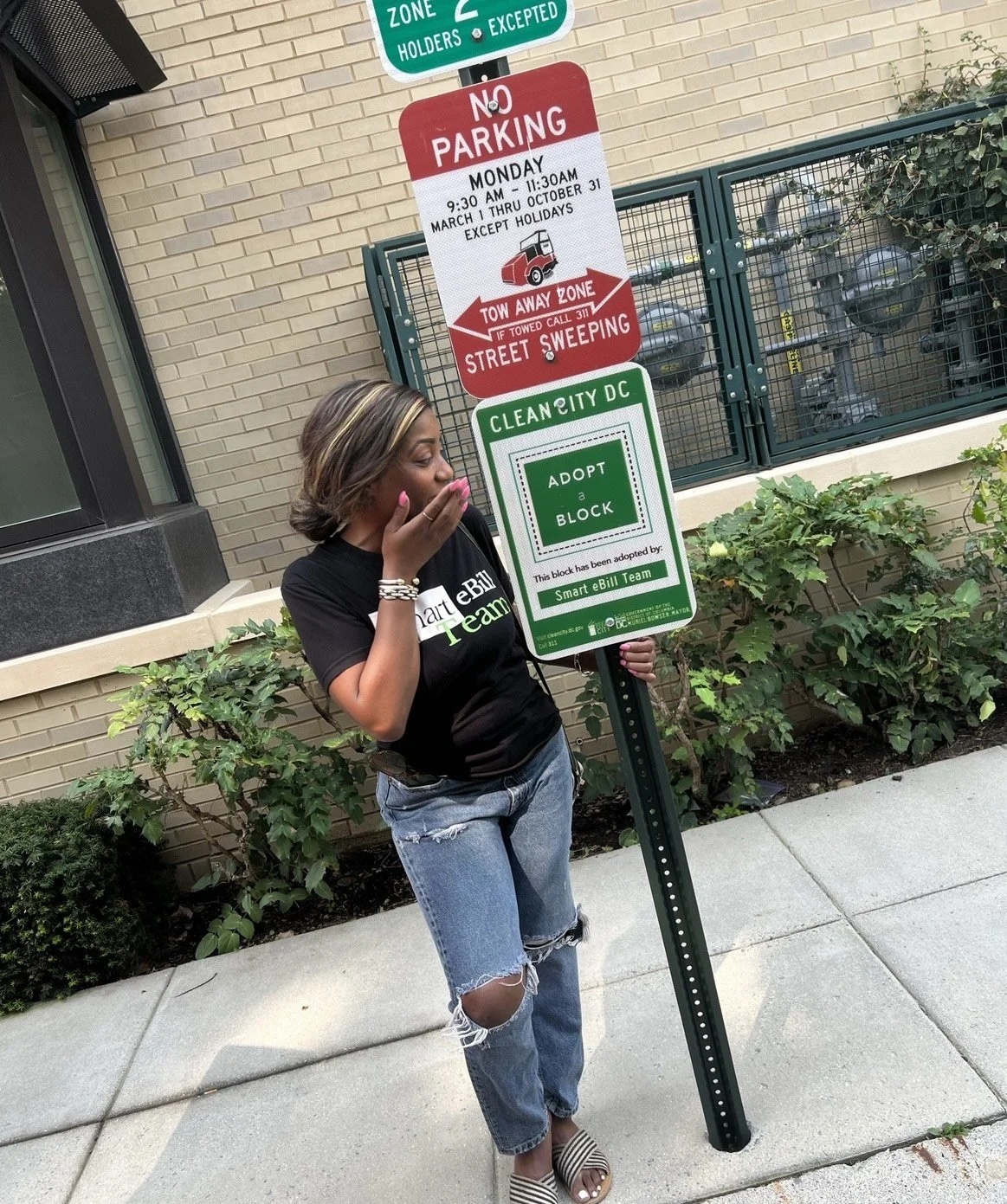
What Is the Adopt-a-Block Program?
Adopt-a-Block is a citywide initiative that empowers local organizations to take ownership of the cleanliness and beautification of their neighborhoods. Through regular cleanups, litter removal, and public space stewardship, participating organizations contribute directly to the quality of life in D.C.
Why We Participate
Civic Engagement: Our headquarters at 1629 K Street NW, Suite 300, places us in the heart of Washington, D.C. We believe it’s our duty to give back to the city that supports our growth.
Team Building: The program provides meaningful opportunities for our team to collaborate outside the office, strengthening our culture of service and shared purpose.
Visible Impact: By helping keep our adopted block clean and inviting, we support a healthier, more vibrant community for residents, businesses, and visitors alike.
Our Results
Since joining the Adopt-a-Block program, Smart eBill Team has organized regular cleanups, removed significant amounts of litter, and worked alongside other local organizations to enhance the urban environment. Our efforts are a direct extension of our core values: innovation, accountability, and a commitment to making a positive impact—both inside and outside the office.
A Call to Action for the Legal Industry
As we honor World Environment Day, we invite our peers in the legal and professional services sectors to join us in embracing sustainable business practices and community engagement. Whether through digital transformation, volunteerism, or environmental advocacy, every action counts.
At Smart eBill Team, we are proving that operational excellence and environmental responsibility go hand in hand. Our 100% paperless model and active role in the Adopt-a-Block program reflect our vision for a smarter, greener, and more connected legal industry.
Join Us on the Journey to a Sustainable Future
If your law firm or legal department is ready to eliminate paper waste, streamline billing, and make a positive impact in your community, Smart eBill Team is your partner for progress.
Contact us at info@smartebillteam.com or visit www.smartebillteam.com to learn more about our solutions and our commitment to sustainability.
Smart eBill Team—Revolutionizing Legal Billing. 100% Paperless. 100% Committed to Our Community. Proudly supporting a cleaner Washington, D.C. on World Environment Day and every day.

The Future of Legal Billing: Trends to Watch in 2025
Legal billing is undergoing a profound transformation. As law firms and corporate legal departments face increasing pressure to deliver value, ensure compliance, and leverage technology, the landscape of legal billing is evolving at a record pace. Staying ahead of these trends is no longer optional—it’s essential for maintaining profitability, client satisfaction, and a competitive edge.
Below, we explore the key trends shaping the future of legal billing in 2025 and beyond.
1. AI-Driven Automation and Smart Workflows
The adoption of artificial intelligence and machine learning is revolutionizing the legal billing process. AI-powered tools can now automate invoice review, flag non-compliance, and even predict billing disputes before they occur. This not only reduces manual workload but also minimizes costly errors and accelerates turnaround times.
Key Takeaway:
Firms leveraging AI-driven billing solutions are seeing measurable improvements in efficiency, accuracy, and client satisfaction.
2. Subscription and Alternative Fee Arrangements (AFAs)
Clients are demanding more predictable and transparent pricing. As a result, law firms are moving away from traditional hourly billing toward subscription models and AFAs—including flat fees, capped fees, and blended rates. This shift aligns legal services with client expectations for value and budget certainty.
Key Takeaway:
Firms that offer flexible billing models are better positioned to win and retain sophisticated clients.
3. Seamless eBilling System Integrations
The days of disconnected billing systems are ending. Modern legal departments expect seamless integrations between eBilling platforms, practice management tools, and accounting systems. This integration streamlines workflows, ensures data accuracy, and enables real-time reporting.
Key Takeaway:
Investing in integrated billing solutions reduces administrative burden and enhances your ability to make data-driven decisions.
4. Enhanced Compliance and Audit Readiness
With the proliferation of Outside Counsel Guidelines (OCGs) and increasing regulatory scrutiny, compliance is more important than ever. Automated compliance checks, audit trails, and real-time validation are becoming standard features in leading billing systems.
Key Takeaway:
Proactive compliance management not only reduces invoice rejections and write-downs but also strengthens client relationships.
5. Client-Centric Billing and Transparency
Clients expect more than just accurate invoices—they want transparency into matter budgets, accruals, and billing status. Firms are responding by providing client portals, real-time updates, and detailed reporting.
Key Takeaway:
Transparent billing practices foster trust and deepen client loyalty.
6. Data-Driven Insights and Analytics
The future of legal billing is data-driven. Advanced analytics tools are empowering firms to track key metrics, identify trends, and optimize billing practices. From benchmarking realization rates to forecasting cash flow, data is now a strategic asset.
Key Takeaway:
Firms that harness analytics can proactively improve profitability and client service.
7. Focus on Training and Change Management
As billing systems become more sophisticated, ongoing training and change management are critical. Firms that invest in continuous education for their billing teams ensure higher adoption rates and fewer costly mistakes.
Key Takeaway:
A well-trained team is essential for maximizing the benefits of new technology and processes.
8. Cybersecurity and Data Privacy
With sensitive billing and client data flowing through multiple platforms, robust cybersecurity measures are non-negotiable. Firms are prioritizing SOC2 compliance, secure data storage, and regular security training to protect client information.
Key Takeaway:
Strong cybersecurity is foundational to client trust and regulatory compliance.
The future of legal billing is bright for firms that embrace innovation, client-centricity, and continuous improvement. By adopting AI-driven automation, flexible billing models, integrated systems, and a culture of compliance, your firm can not only keep pace with industry changes but also set the standard for excellence.
At Smart eBill Team, we are committed to guiding law firms and legal departments through this evolving landscape—offering the expertise, technology training and implementation , and support needed to thrive in 2025 and beyond.
Ready to future-proof your billing process?
Contact us today to learn how our tailored solutions can help your firm stay ahead of the curve.
Info@smartebillteam.com http://www.smartebillteam.com

The Future of Legal Billing: Trends to Watch in 2025
Legal billing is undergoing a profound transformation. As law firms and corporate legal departments face increasing pressure to deliver value, ensure compliance, and leverage technology, the landscape of legal billing is evolving at a record pace. Staying ahead of these trends is no longer optional—it’s essential for maintaining profitability, client satisfaction, and a competitive edge.
Below, we explore the key trends shaping the future of legal billing in 2025 and beyond.
1. AI-Driven Automation and Smart Workflows
The adoption of artificial intelligence and machine learning is revolutionizing the legal billing process. AI-powered tools can now automate invoice review, flag non-compliance, and even predict billing disputes before they occur. This not only reduces manual workload but also minimizes costly errors and accelerates turnaround times.
Key Takeaway:
Firms leveraging AI-driven billing solutions are seeing measurable improvements in efficiency, accuracy, and client satisfaction.
2. Subscription and Alternative Fee Arrangements (AFAs)
Clients are demanding more predictable and transparent pricing. As a result, law firms are moving away from traditional hourly billing toward subscription models and AFAs—including flat fees, capped fees, and blended rates. This shift aligns legal services with client expectations for value and budget certainty.
Key Takeaway:
Firms that offer flexible billing models are better positioned to win and retain sophisticated clients.
3. Seamless eBilling System Integrations
The days of disconnected billing systems are ending. Modern legal departments expect seamless integrations between eBilling platforms, practice management tools, and accounting systems. This integration streamlines workflows, ensures data accuracy, and enables real-time reporting.
Key Takeaway:
Investing in integrated billing solutions reduces administrative burden and enhances your ability to make data-driven decisions.
4. Enhanced Compliance and Audit Readiness
With the proliferation of Outside Counsel Guidelines (OCGs) and increasing regulatory scrutiny, compliance is more important than ever. Automated compliance checks, audit trails, and real-time validation are becoming standard features in leading billing systems.
Key Takeaway:
Proactive compliance management not only reduces invoice rejections and write-downs but also strengthens client relationships.
5. Client-Centric Billing and Transparency
Clients expect more than just accurate invoices—they want transparency into matter budgets, accruals, and billing status. Firms are responding by providing client portals, real-time updates, and detailed reporting.
Key Takeaway:
Transparent billing practices foster trust and deepen client loyalty.
6. Data-Driven Insights and Analytics
The future of legal billing is data-driven. Advanced analytics tools are empowering firms to track key metrics, identify trends, and optimize billing practices. From benchmarking realization rates to forecasting cash flow, data is now a strategic asset.
Key Takeaway:
Firms that harness analytics can proactively improve profitability and client service.
7. Focus on Training and Change Management
As billing systems become more sophisticated, ongoing training and change management are critical. Firms that invest in continuous education for their billing teams ensure higher adoption rates and fewer costly mistakes.
Key Takeaway:
A well-trained team is essential for maximizing the benefits of new technology and processes.
8. Cybersecurity and Data Privacy
With sensitive billing and client data flowing through multiple platforms, robust cybersecurity measures are non-negotiable. Firms are prioritizing SOC2 compliance, secure data storage, and regular security training to protect client information.
Key Takeaway:
Strong cybersecurity is foundational to client trust and regulatory compliance.
The future of legal billing is bright for firms that embrace innovation, client-centricity, and continuous improvement. By adopting AI-driven automation, flexible billing models, integrated systems, and a culture of compliance, your firm can not only keep pace with industry changes but also set the standard for excellence.
At Smart eBill Team, we are committed to guiding law firms and legal departments through this evolving landscape—offering the expertise, technology training and implementation , and support needed to thrive in 2025 and beyond.
Ready to future-proof your billing process?
Contact us today to learn how our tailored solutions can help your firm stay ahead of the curve.
Info@smartebillteam.com
[www.smartebillteam.com](http://www.smartebillteam.com)

The Ultimate Guide to Legal Billing Compliance
Legal billing compliance is no longer optional—it’s a critical pillar for any law firm or corporate legal department that wants to protect its revenue, reputation, and client relationships. In today’s legal landscape, where guidelines are more complex and clients expect transparency and accuracy, even a single compliance misstep can mean delayed payments, write-downs, or lost business. But with the right framework, your team can turn compliance from a headache into a competitive advantage.
1. Master the Client’s Guidelines
Every client is different, and Outside Counsel Guidelines (OCGs) are rarely straightforward. They might dictate everything from what constitutes a billable task to how time should be recorded and which expenses are reimbursable. The smallest oversight—using the wrong task code, billing for a non-permissible activity, or missing a required narrative—can trigger a rejection.
What works:
Create a centralized, easily accessible repository of all client guidelines.
Summarize and highlight the most critical “must-follow” rules for each client, so your team never has to dig for details under deadline.
Build checklists for each client to use before invoice submission, and update them regularly as guidelines change.
2. Invest in Technology—But Don’t Forget the People
eBilling platforms are the backbone of modern legal billing. Systems like Tymetrix 360, Collaborati, Brightflag, and others can automate compliance checks, flag missing data, and standardize invoice formats. But technology alone isn’t enough: you need people who know how to use it.
What works:
Choose platforms that support your clients’ preferred formats (LEDES, UTBMS, etc.) and have robust validation tools.
Automate wherever possible—recurring matters, accruals, appeals, or reporting—so your team can focus on exceptions and higher-value work.
Integrate your billing system with your timekeeping and accounting tools for seamless, error-free data flow.
3. Train for Excellence—And Accountability
Your billing team is your first line of defense against compliance risks. Even the best systems can’t compensate for a lack of training or awareness. Regular, targeted training ensures everyone understands both the “why” and the “how” of compliance.
What works:
Offer ongoing training sessions, not just one-and-done orientations.
Use real examples from your own client base to illustrate pitfalls and best practices.
Make compliance part of your team’s KPIs—reward accuracy and proactive problem-solving.
4. Standardize, Then Customize
Consistency is the foundation of compliance. By standardizing your templates, narratives, and workflows, you minimize the risk of human error. But don’t forget to customize for each client—one size rarely fits all.
What works:
Develop master templates for your most common billing scenarios, with pre-approved language and codes.
Document your workflow from time entry to invoice submission, so new team members can get up to speed quickly.
Allow for quick customization to reflect each client’s unique requirements without reinventing the wheel every time.
5. Monitor, Audit, and Appeal—Relentlessly
Compliance isn’t a box you check once. It’s an ongoing process that requires vigilance and continual improvement. Regular audits help you spot trends—like common rejection reasons—so you can address root causes.
What works:
Schedule monthly or quarterly compliance audits using a mix of automated tools and manual reviews.
Track every rejection with reasons and resolutions, then share findings with your team.
Build a structured appeals process, so rejected invoices don’t fall through the cracks.
6. Stay Ahead of Regulatory and Industry Changes
Billing compliance isn’t just about client guidelines—it’s also about broader legal and regulatory frameworks. From ABA rules to local tax regulations, staying informed is essential.
What works:
Assign a compliance lead or committee to monitor regulatory updates and industry best practices.
Subscribe to legal billing newsletters, attend webinars, and participate in professional associations.
Review and update your internal policies at least annually, if not more often.
7. Know When to Bring in the Experts
Sometimes, the smartest move is outsourcing. Legal billing compliance is intricate and ever-evolving. Partnering with a dedicated team—like Smart eBill Team—means your firm or department benefits from deep expertise, up-to-date knowledge, and scalable support.
What works:
Work with consultants who have hands-on experience in legal billing, not just theoretical knowledge.
Leverage outside support for training, compliance reviews, or overflow work during peak periods.
Use external audits to get an unbiased view of your compliance health.
Final Thoughts
Legal billing compliance is a team sport. It’s about systems, training, vigilance, and the willingness to adapt. Firms and departments that get it right see fewer rejections, faster payments, and stronger client relationships. Those that don’t risk lost revenue and eroded trust.
If you’re ready to transform your billing process—and turn compliance into your competitive edge—Smart eBill Team is here to help. Our seasoned professionals have walked in your shoes, and we know what it takes to get billing right, every time.

How We Help Firms Reduce Errors by 40%
In the fast-paced world of legal billing, accuracy is non-negotiable. Errors in invoices can lead to costly rejections, delayed payments, and strained client relationships. At Smart eBill Team, we’ve developed a proven approach to help law firms and legal departments reduce billing errors by up to 40%, ensuring smoother operations and stronger financial outcomes. Here’s how we do it:
1. Comprehensive Invoice Review & Compliance Checks
One of the leading causes of billing errors is non-compliance with client-specific billing guidelines. These guidelines can be complex and vary significantly from client to client.
How We Help
- Our team of eBilling specialists meticulously reviews every invoice to ensure it adheres to client policies.
- We use advanced tools to flag potential errors before invoices are submitted, reducing the likelihood of rejections.
- By proactively addressing compliance issues, we help firms maintain strong client relationships and avoid costly delays
2. Expert Training for In-House Teams
Even the most sophisticated billing systems require skilled users to operate them effectively. Without proper training, teams are more likely to make errors in data entry, coding, or system navigation.
How We Help
- We provide customized training programs tailored to your team’s needs, focusing on best practices for using eBilling platforms.
- Our training includes troubleshooting common errors, improving time recording practices, and understanding client-specific requirements.
- With a well-trained team, firms can significantly reduce manual errors and improve overall efficiency.
3. Leveraging Technology for Error Prevention
Technology plays a crucial role in minimizing errors, but only when it’s used effectively. Many firms struggle to configure their systems optimally, leading to recurring issues.
How We Help
- We assist in configuring eBilling systems, including mapping vendors, updating user-defined fields, and ensuring proper LEDES file formatting.
- Our expertise spans platforms like Tymetrix 360, Collaborati, Brightflag, and more, allowing us to recommend the best tools for your needs.
- By setting up systems correctly and providing ongoing support, we eliminate common technical errors that disrupt the billing process.
4. Tailored Solutions for Complex Billing Needs
Every firm has unique billing challenges, whether it’s high-volume invoicing, multiple jurisdictions, or intricate client requirements.
How We Help
- We offer tailored solutions to address your firm’s specific needs, from creating customized templates to managing complex billing workflows.
- Our team works closely with your staff to identify pain points and implement strategies that streamline processes and reduce errors.
- This personalized approach ensures that your billing system is not only accurate but also efficient and scalable.
5. Ongoing Monitoring and Support
Billing isn’t a one-and-done task. It requires continuous monitoring to ensure compliance and accuracy over time.
How We Help
- We provide ongoing support to address any issues that arise, whether it’s reconciling invoices, troubleshooting technical problems, or updating client guidelines.
- Our regular audits identify potential errors before they become costly problems, giving you peace of mind and confidence in your billing process.
Proven Results
By combining expertise, technology, and a client-centric approach, we’ve helped firms achieve:
- 40% fewer billing errors through meticulous compliance checks and training.
- 50% faster invoice turnaround times by streamlining workflows and optimizing systems.
- Stronger client relationships thanks to accurate, timely, and compliant billing practices.
Ready to Reduce Billing Errors at Your Firm?
At Smart eBill Team we’re committed to helping law firms and legal departments achieve billing excellence. Let us handle the complexities of eBilling so you can focus on what you do best—practicing law.
📩 Contact us today to learn more about our services or visit http://www.smartebillteam.com.
#LegalBilling #Compliance #Efficiency #SmartBillingSolutions #ClientSuccess

Streamline Your Billing Process: Expert Tips from Smart eBill Team
Efficient billing is the backbone of any successful law firm or corporate legal department. Yet, many organizations struggle with challenges like compliance issues, rejected invoices, and time-consuming manual processes. At Smart eBill Team, we specialize in helping law firms and legal departments streamline their billing processes, empowering them to focus on their core legal work.
Here are three expert tips to help you optimize your billing workflow:
1. Choose the Right eBilling System
Selecting the right eBilling system is crucial for improving efficiency and ensuring compliance. Every firm has unique needs, and the right platform can help reduce errors, improve turnaround times, and enhance overall performance.
How We Help: While we don’t currently use AI in our services, we leverage it to recommend the best eBilling systems tailored to your firm’s requirements. Our expertise spans platforms like, Aderant, Elite, Salvo, eBillinghub, Billblast, Tymetrix 360, Collaborati, Brightflag, Legal Tracker and more.
2. Train Your Team for Success
Even the best systems can fall short if your team isn’t properly trained to use them. Regular training ensures your team is equipped to handle billing complexities and stay up-to-date with client requirements.
How We Help: Our Training & Implementation services provide customized programs to help your team master eBilling systems, troubleshoot errors, and improve time recording.
3. Prioritize Compliance and Accuracy
Rejections due to non-compliance are costly and time-consuming. Ensuring that every invoice adheres to client guidelines is critical to maintaining strong client relationships and improving cash flow.
How We Help: Our Invoice Review & Compliance service ensures every invoice is accurate, compliant, and processed efficiently, reducing rejections and saving you time.
At Smart eBill Team, we combine deep industry knowledge with advanced tools to help law firms and legal departments achieve billing excellence. Let us take the stress out of billing so you can focus on what you do best—practicing law.
📩 Ready to streamline your billing process? Contact us today to discuss how we can help. Visit our website at www.smartebillteam.com or schedule a free consultation now!
Why Choose Smart eBill Team?
Expertise in diverse legal billing systems.
Proven track record of reducing errors and improving efficiency.
Client-centric solutions tailored to your unique needs.
Let us take the stress out of billing so you can focus on your core practice.
#LegalBilling #Compliance #Efficiency #SmartBillingSolutions #LegalTech

Revolutionizing Legal Billing: How Smart eBill Team is Transforming the Industry
In the fast-paced world of legal billing, efficiency, accuracy, and compliance are non-negotiable. Legal billing departments face significant challenges every year, from managing high-volume invoices to adhering to complex client guidelines. At Smart eBill Team, we’ve made it our mission to simplify and supercharge the eBilling process, empowering law firms and corporate legal departments to focus on what truly matters—their clients.
The Challenges of Legal Billing
Legal billing can be a daunting task. Firms often encounter issues like:
- Costly Write-Offs Errors in invoices often lead to write-downs or write-offs, affecting profitability.
- Compliance Complexities Adhering to diverse client billing guidelines can be time-consuming and prone to errors.
- Resource Constraints Many teams lack the expertise or tools to efficiently manage billing processes.
These challenges not only hurt the bottom line but can also strain client relationships. That’s where Smart eBill Team steps in.
Our Expertise: A Game-Changer for Legal Billing
With over 500 years of combined legal billing experience, Smart eBill Team is uniquely positioned to tackle the industry's toughest challenges. Here’s how we make a difference:
1. Comprehensive eBilling Solutions
From invoice submission to compliance reviews, we handle every aspect of the billing process. Our services include client onboarding, system configuration, and even appeals for rejected invoices.
2. AI-Driven Technology
We leverage cutting-edge automation tools to reduce errors and streamline workflows. By automating repetitive tasks, we ensure faster turnaround times and greater accuracy.
3. Tailored Training Programs
Our customized training and educational tools empower in-house teams to maximize their billing efficiency. We also provide outside counsel billing guideline summaries to help teams stay compliant.
4. Proven Results
To date, we’ve successfully eBilled over $65 million in invoice totals, helping our clients reduce write-offs and improve profitability.
Why Choose Smart eBill Team?
Our commitment to excellence goes beyond technology and expertise. We pride ourselves on being a client-centric partner, offering personalized support and transparent communication every step of the way. Here’s what sets us apart:
- Scalable Solutions: Whether you’re a boutique law firm or a Fortune 500 company, our services adapt to your needs.
- Trusted by Industry Leaders: We’ve earned the trust of top law firms and corporate legal departments worldwide.
- Focus on Client Satisfaction: Our goal is to help you maintain strong client relationships while enhancing your financial accuracy.
Looking Ahead: The Future of Legal Billing
At Smart eBill Team, we believe the future of legal billing lies in the perfect blend of technology, expertise, and a client-first approach. Our vision is to set the industry standard, making eBilling seamless and stress-free for legal teams across the globe.
Start Your Journey with Smart eBill Team
If your legal billing process feels like a constant uphill battle, we’re here to help. Contact us today to learn how our tailored solutions can transform your billing operations and set you up for success.
Stay tuned for more insights, tips, and updates from the Smart eBill Team. We’ll be back next Monday with another blog post to help you navigate the world of legal billing with ease.

eBilling vs. eInvoicing: Understanding the Key Differences
Introduction
In today’s digital world, businesses and legal departments are constantly seeking efficient financial processes to manage transactions, billing, and compliance. Two commonly used terms in financial management—eBilling and eInvoicing—may seem similar but serve distinct purposes. Understanding their differences, benefits, and applications is essential for companies looking to streamline financial workflows.
What is eBilling?
eBilling (Electronic Billing) refers to the process of submitting, tracking, and processing bills electronically, usually through a specialized billing system or legal eBilling platforms such as Tymetrix, CounselLink, and Brightflag.
Key Features of eBilling:
✅ Standardized Formats: Uses structured data formats like LEDES (Legal Electronic Data Exchange Standard) for compliance in legal billing.
✅ Automated Compliance Checks: Ensures invoices adhere to billing guidelines set by clients, law firms, or corporations.
✅ Integration with Financial Systems: Connects with enterprise resource planning (ERP) and legal spend management tools.
✅ Approval Workflow Management: Includes automated review and approval processes to streamline payments.
Who Uses eBilling?
Law firms and corporate legal departments to manage legal expenses and ensure compliance.
Healthcare providers for insurance claim processing.
Utility companies and subscription-based services that require recurring bill submissions.
What is eInvoicing?
eInvoicing (Electronic Invoicing) is a broader term that refers to the electronic creation, transmission, and storage of invoices between vendors and buyers. Unlike eBilling, which often involves compliance checks and legal requirements, eInvoicing focuses on transactional efficiency.
Key Features of eInvoicing:
✅ Invoice Generation & Transmission: Digitally creates and sends invoices in formats like XML, PDF, or UBL (Universal Business Language).
✅ Tax Compliance: Ensures adherence to government tax regulations, such as VAT reporting in Europe or IRS e-filing in the U.S.
✅ Payment Processing Integration: Connects with accounts payable (AP) and accounts receivable (AR) systems.
✅ Global B2B and B2G Compliance: Aligns with international regulations, such as Peppol for European transactions.
Who Uses eInvoicing?
Corporations and businesses managing vendor payments and tax reporting.
Government agencies requiring structured eInvoices for public contracts.
Freelancers and small businesses for simplified invoice tracking and digital payment processing.
eBilling vs. eInvoicing: A Side-by-Side Comparison

Choosing the Right Solution for Your Business
🔹 If you are a law firm, legal department, or a business requiring compliance-based billing, eBilling is the best option.
🔹 If you are a business handling vendor payments and tax invoices, eInvoicing offers broader financial management capabilities.
Conclusion
While eBilling and eInvoicing both contribute to digital financial efficiency, they serve different purposes. eBilling ensures compliance and structured billing for specialized industries, whereas eInvoicing streamlines business transactions and tax compliance. Understanding these differences can help businesses choose the right solution for their needs and optimize financial workflows. For more information contact Smart eBill Team at info@smartebillteam.com

Exciting Changes Ahead: Smart eBill Team’s New Look and Feel!
At Smart eBill Team, we’re always striving to improve and evolve to better serve our clients. As part of this ongoing commitment, we’re thrilled to announce that we’re updating our logo colors to better reflect our growth and dedication to delivering the best possible service to both law firms and legal departments.
While we’ll still use our original logo colors in select instances, our new signature colors are black, white, and Smart eBill Blue—a bold and professional blue that perfectly represents both the trust we’ve built and the innovative approach we bring to legal billing. These colors symbolize clarity, professionalism, and the modern solutions we provide.
But we’re not just updating our look—we’re rebranding for the future. Along with our new colors, we’re also introducing a new slogan:
"Smart, Simple, Legal Billing."
This tagline speaks directly to our core mission: to provide efficient, intuitive, and seamless e-billing solutions that empower law firms and legal departments to focus on what truly matters—serving their clients and handling complex legal operations. With this slogan, we’re reinforcing our commitment to simplifying the complexities of legal billing, making it smarter and simpler for every client we serve.
What’s Coming Next? Website Updates!
We’re not stopping at the new logo and slogan. Over the next few months, you’ll notice exciting updates to our website! We’re revamping it to give you an even more intuitive, user-friendly experience, featuring new tools and resources that will help you manage your e-billing more efficiently than ever before.
Expect smoother navigation, enhanced features, and a fresh design that aligns perfectly with our new branding—making it easier than ever for you to access the support and tools you need to elevate your billing processes.
Why the Change?
As Smart eBill Team continues to grow, we felt it was the perfect time to reflect that growth with a visual update that highlights our progress, reliability, and innovation. Our new black, white, and Smart eBill Blue color palette is sleek, professional, and modern, designed to make your experience with us feel fresh and dynamic.
We’re incredibly excited about this next phase, and we can’t wait to share all the upcoming changes with you. Thank you for being part of the Smart eBill Team family. We’re committed to helping you simplify and streamline your legal billing—and with these changes, we’re just getting started!
Smart eBill Team: Smart, Simple, Legal Billing.

Moving Forward Together: A Message from the Smart eBill Team
Dear Clients, Partners, and Supporters,
As the recent election has concluded, we recognize that it has stirred a variety of emotions across the country. Whether you’re feeling hopeful, uncertain, or disappointed, we understand that these moments can bring about strong reactions. It’s important to acknowledge these feelings while remembering that we are all committed to working together toward shared goals and successes.
At Smart eBill, we remain focused on the core mission that unites us: delivering innovative, accurate, and efficient billing solutions to our clients and partners. No matter the outcome of the election, we are dedicated to providing the same high level of service and support you’ve come to expect from us.
How We Can Move Forward Together:
Respecting Diverse Perspectives: We know that our clients and partners come from diverse backgrounds, with unique perspectives shaped by personal, professional, and political beliefs. While we may not all agree on every issue, we are united by a common goal: delivering high-quality, efficient solutions that support the work you do. We encourage empathy and respectful dialogue as we continue to collaborate toward the future.
Focused on What Matters: At Smart eBill, our primary goal remains to provide seamless, accurate, and reliable billing solutions. Whether it’s processing LEDES files, managing your invoicing needs, or ensuring compliance with the latest legal industry standards, our commitment to supporting you has not changed. We understand that clear and accurate billing, especially with standards like LEDES, is critical to your success, and we will continue to provide solutions that enhance your workflow and simplify the billing process.
Open Communication and Support: As we navigate through a time of uncertainty, we want to remind you that we are here to listen and support you. If you have any questions or concerns related to your billing processes, LEDES compliance, or any other needs, our team is always available to help. We encourage you to reach out to us for assistance, whether you need technical support or simply want to discuss how we can better serve you moving forward.
Strengthening Our Partnerships: We understand that elections can be divisive, but at Smart eBill, we believe that the strength of our partnerships is what truly matters. Our success is rooted in the trust we’ve built with you, our clients, and our ability to work together to solve complex challenges. As always, we are committed to providing exceptional service and helping you achieve your goals—whether that involves navigating complex LEDES billing requirements or finding innovative solutions to streamline your operations.
Embracing Unity and Diversity: The diversity of thought and experience within our client base is one of the reasons we are so proud of the work we do. It’s this diversity that allows us to innovate and continually improve the solutions we provide. As we move forward, let’s continue to celebrate our differences and focus on the shared values that drive us—excellence, collaboration, and progress.
In Conclusion:
While the election results may have sparked strong emotions for many, we remain focused on what matters most: your success. At Smart eBill, we are committed to providing the reliable, efficient, and accurate billing solutions that help your team thrive. Whether you need assistance with LEDES billing, navigating electronic invoicing, or any other aspect of your workflow, we are here for you every step of the way.
Thank you for your continued trust and partnership. Together, we will move forward, stronger and more united in our shared mission.
With appreciation and respect,
The Smart eBill Team

Navigating the Challenges of Split Invoices in Legal eBilling and LEDES Files
Handling split invoices, where multiple payors share responsibility for payment, introduces several complexities into the legal eBilling process. These challenges are compounded by the limitations of consolidation systems like eBillingHub and Billblast, which often struggle to effectively manage and track split invoices. Below is a detailed analysis of these issues and potential solutions.
1. Payment Processing from Multiple Payors
Issue: When an invoice is divided among several payors, payments come from multiple sources, each with its own billing guidelines and requirements. Different companies may have varying requirements, such as different deadlines, additional data requests, preapproval needs, or specific activity codes.
Complications:
Different Billing Systems: Each payor may require their portion of the invoice to be processed through a different eBilling system.
Invoice Reviewing Periods: Payors may have different review periods, causing delays or mismatches in payment processing.
Rejections: Handling rejections from one payor while others accept their portions can be complex and time-consuming.
Service Allocation: Determining which payor covers specific expenses or services can add further complexity.
Resolution:
Unified Submission: Where possible, consolidate all payor requirements into a single eBilling submission to streamline processing and avoid multiple systems.
Clear Documentation: Include comprehensive notes on the invoice detailing how it is split, which payor is responsible for which portion, and any special instructions or additional data requests.
Regular Communication: Maintain open lines of communication with all payors to address issues promptly and ensure clarity regarding invoice portions, deadlines, and requirements.
2. Discrepancies in Invoice Review Periods
Issue: Different payors may have varied review periods, affecting the speed of invoice processing and payments.
Complications:
Delayed Payments: Variability in review periods can lead to delays in payments, impacting cash flow.
Inconsistent Approvals: Different review schedules can result in misalignment in the approval and payment of invoice portions.
Resolution:
Standardize Review Timelines: Collaborate with all involved parties to establish standardized review periods or, at a minimum, understand and plan for differences.
Track Review Status: Implement tracking systems to monitor the status of invoice reviews across all payors.
3. Handling Rejections and Reviews
Issue: Managing rejections from one payor while others accept portions of the invoice requires additional review and resolution.
Complications:
Partial Payments: Managing partial payments from multiple payors complicates financial tracking and reconciliation.
Increased Administrative Work: Additional time and effort are needed to address rejections and ensure all parties are satisfied.
Resolution:
Detailed Review Procedures: Develop clear procedures for managing rejections, including documentation and communication protocols.
Resolution Workflow: Create a systematic workflow for addressing and resolving rejected invoice portions, including follow-ups with payors.
4. Foreign Trading Values and Multiple Taxes
Issue: Different payors might be subject to varying foreign trading values and tax requirements.
Complications:
Currency Conversion Issues: Fluctuations in foreign trading values can lead to discrepancies in billing amounts.
Tax Compliance: Different jurisdictions may have specific tax regulations, complicating the invoicing process.
Resolution:
Consistent Currency Conversion: Use reliable and consistent currency conversion methods and clearly document these on the invoice.
Tax Compliance Checks: Ensure compliance with tax regulations in all relevant jurisdictions, including accurate calculation and documentation of applicable taxes.
5. Differentiated Service Payments
Issue: One payor may be responsible for specific services while another is not, affecting how the invoice is split.
Complications:
Service Allocation: Accurately allocating costs for specific services among payors can be challenging and prone to errors.
Payment Discrepancies: Discrepancies in service payments can lead to disputes and delays.
Resolution:
Clear Service Allocation: Clearly specify which services each payor is responsible for and reflect this in the invoice details.
Itemized Billing: Use itemized billing to show which portions of the invoice correspond to specific services.
6. Insurance Payors and Capped Rates
Issue: Multiple insurance payors may impose specific billing requirements, such as capped rates or consolidated billing after litigation.
Complications:
Rate Limits: Insurance payors may set caps on the amount they will pay, requiring adjustments to the invoice amounts.
Consolidated Billing Requirements: Some insurance payors may only accept invoices billed after a case concludes, complicating interim billing.
Resolution:
Adhere to Capped Rates: Ensure invoice amounts comply with the capped rates specified by insurance payors.
Consolidated Billing Coordination: Coordinate with insurance payors to understand their billing preferences and comply with their requirements for consolidated billing.
7. Limitations of Consolidation Systems
Issue: Systems like eBillingHub and Billblast often struggle to effectively manage and track split invoices, exacerbating the challenges.
Complications:
Ineffective Tracking: These systems may lack the functionality to handle multiple payors and their specific requirements effectively.
Resolution:
Enhanced Integration: Explore additional tools or systems designed to better manage split invoices and improve tracking across multiple payors.
System Upgrades: Consider upgrading or customizing existing systems to better accommodate the complexities of split invoices.
By addressing these challenges through careful planning, thorough documentation, and effective communication, and by leveraging improved tools and systems, legal eBilling processes can be streamlined. This approach minimizes issues and ensures more efficient financial transactions, despite the complexities associated with split invoices.